







Choosing the right strength training equipment can help you build a practical home gym that supports steady progress without wasting space or money. The best setup depends on your goals, available room, experience level and the types of exercises you plan to perform regularly.
A beginner may only need dumbbells, resistance bands and a bench, while someone training with heavier loads may benefit from a rack, barbell and weight plates. Larger machines can add variety and support controlled movement, but they require more floor space, higher costs and careful planning.
This guide compares the main types of strength training equipment for home use and explains what to consider before buying.
Strength Training Equipment: Quick Comparison
| Equipment | Best for | Space required | Typical experience level |
|---|---|---|---|
| Dumbbells | Full-body strength training | Low | Beginner to advanced |
| Resistance bands | Strength, mobility and warm-ups | Very low | Beginner to advanced |
| Adjustable bench | Presses, rows and supported exercises | Moderate | Beginner to advanced |
| Kettlebells | Strength and conditioning | Low | Beginner to advanced |
| Barbell and plates | Progressive heavy lifting | Moderate | Intermediate to advanced |
| Power rack or squat rack | Safer barbell training | High | Intermediate to advanced |
| Home gym machine | Guided multi-exercise training | High | Beginner to advanced |
Start With Your Strength Training Goals
Before buying strength training equipment, decide what you want the setup to achieve. This helps prevent purchasing large or specialised items that do not suit your routine.
Common goals include:
- Building general strength
- Increasing muscle size
- Supporting sport or physical work
- Improving balance and joint stability
- Training at home instead of attending a commercial gym
- Maintaining strength as part of a broader fitness program
Someone focused on general strength may only need adjustable dumbbells and a bench. A person training for barbell squats, deadlifts and presses will require more equipment, including a suitable rack, plates and flooring.
Our guide to how to choose fitness equipment provides more help matching equipment to your available space, goals and budget.
Dumbbells for Versatile Home Strength Training
Dumbbells are often the first piece of strength training equipment people add to a home gym because they support many exercises without requiring a large footprint.
Dumbbells are one of the most versatile forms of home strength equipment. They can be used for presses, rows, squats, lunges, carries, curls, extensions and many other exercises.
Fixed dumbbells are simple to use and allow quick weight changes when several pairs are available. However, a complete set requires more storage space and can become expensive as resistance increases.
Adjustable dumbbells combine several weight levels in one compact system. They are often better suited to small home gyms, although changing the load may take longer depending on the design.
Our comparison of adjustable dumbbells versus fixed dumbbells explains the advantages and limitations of each option.
Browse current free weights for dumbbells, kettlebells and related training products.
Resistance Bands for Compact Strength Equipment
Among the most compact types of strength training equipment, resistance bands require very little storage space and can support strength work, warm-ups, assistance exercises and controlled mobility training. Different band thicknesses provide different resistance levels, allowing the difficulty to be adjusted without adding large weights.
Bands may be used for rows, presses, squats, lateral walks, shoulder exercises and assisted bodyweight movements. They can also complement free weights by adding resistance through a different range of motion.
Because tension increases as the band stretches, the resistance feels different from a dumbbell or barbell. Inspect bands regularly and replace them if they become cracked, worn or damaged.
See our guide to the benefits of resistance bands for strength training for more detail.
Adjustable Benches Expand Exercise Options
An adjustable bench is a valuable piece of strength training equipment because it increases the number of supported pressing, rowing and lower-body exercises available in a home gym.
An adjustable bench can significantly expand a home strength setup. It provides support for seated and lying exercises and allows flat, incline and sometimes decline positions.
Common exercises include:
- Dumbbell bench presses
- Incline presses
- Supported rows
- Seated shoulder presses
- Step-ups
- Split squats
Before buying, check the bench’s weight rating, adjustment mechanism, pad width and overall stability. A folding model may reduce storage space, but it should still feel secure during use.
Allow enough room to move around the bench and handle weights safely. The stored dimensions are important, but the full operating footprint matters more during training.
Kettlebells for Strength and Conditioning
Kettlebells are versatile strength training equipment that can support both controlled strength exercises and dynamic conditioning movements. They are commonly used for goblet squats, deadlifts, presses, rows, carries and swings.
A single kettlebell can provide a compact starting point, while several weights allow progression across different exercises. Adjustable kettlebells can reduce storage requirements, although fixed models may be quicker to use.
Dynamic exercises require enough clear space and correct technique. Beginners should first learn controlled movements before progressing to faster exercises such as swings or cleans.
Kettlebells can be particularly useful when the goal is to combine strength, coordination and cardiovascular effort in shorter sessions.
Barbells and Weight Plates for Progressive Training
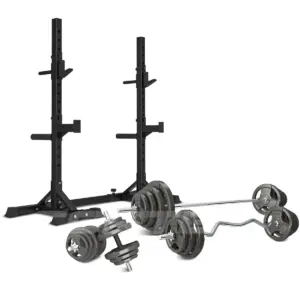
A barbell and weight plates are useful strength training equipment for people who want to develop heavier squats, deadlifts, presses and rows. They make gradual load increases easier and can support long-term progression.
However, barbell training needs more planning than a basic dumbbell setup. Consider the bar length, plate type, floor protection, storage and space required to load and unload the bar.
Olympic bars and plates are commonly used for heavier training, while standard bars may suit lighter home setups. Check that the bar, plates, collars and rack are compatible before purchasing.
Some exercises can be performed from the floor, but squats and bench presses generally require a suitable rack and safety system. Avoid attempting heavy lifts without an appropriate setup.
Power Racks and Squat Racks
As strength training equipment for barbell exercises, a power rack or squat rack holds the bar at an adjustable height. A full power rack usually provides more enclosure and safety options, while a squat rack may have a smaller footprint.
Important features include:
- Maximum load rating
- Adjustable J-hooks
- Safety arms or straps
- Pull-up bar
- Floor anchoring requirements
- Ceiling height
- Compatibility with benches and attachments
Measure the full area before ordering. Allow extra room for the barbell extending beyond each side of the rack, loading plates and performing exercises safely.
Browse the strength equipment category for benches, racks and home training systems.
Home Gym Machines and Functional Trainers
Home gym machines are larger pieces of strength training equipment that can combine several exercises into one structure. Depending on the design, they may include chest presses, rows, pulldowns, leg extensions, cable exercises and other guided movements.
These systems can suit people who prefer fixed movement paths or want multiple exercise stations in one unit. Functional trainers use adjustable cables and handles, allowing a wider range of movement than many fixed machines.
Before choosing a machine, check:
- The exercises included
- The available resistance
- User height and weight limits
- Operating dimensions
- Ceiling clearance
- Delivery access
- Assembly requirements
- Replacement cable and parts availability
A machine may appear compact in product photos but require considerable room once the arms, cables and seats are in use.
Our article on free weights versus machines compares the main differences between these training styles.
Bodyweight Strength Equipment
Bodyweight training can also be expanded with compact strength training equipment. Pull-up bars, push-up handles, suspension trainers, dip stations and gymnastic rings can support a wide range of upper-body and core exercises.
These items may be useful when floor space is limited, but attachment points must be secure and suitable for the expected load. Doorway bars and suspension systems should be installed and used exactly as directed by the manufacturer.
Bodyweight equipment often works well alongside dumbbells or resistance bands, creating a more complete home setup without a large machine.
Choosing Strength Equipment for a Small Home Gym
Small spaces benefit from strength training equipment that supports several exercises and can be stored easily. Adjustable dumbbells, resistance bands, a folding bench and one kettlebell can provide a practical strength setup for many people.
Before purchasing, measure:
- Available floor area
- Ceiling height
- Doorway and hallway access
- Storage space
- Clearance needed for each movement
Avoid filling the available room with equipment before you know how the space will function. Start with versatile items and add larger products only when they solve a clear training need.
Our guide to the best fitness equipment for small spaces includes more planning and storage considerations.
Strength Training Equipment Safety
All strength training equipment should be assembled correctly and used within its stated limits. Check bolts, adjustment pins, cables, welds and locking mechanisms regularly.
Use suitable flooring under heavier equipment to help protect both the equipment and the surface beneath it. Keep plates, dumbbells and accessories stored securely so they do not create trip hazards.
Begin with manageable resistance and learn each exercise before increasing the load. Use safety arms, catches or a spotter when appropriate. Stop training if you experience sharp pain, dizziness or unusual symptoms.
People returning from injury or managing a health condition should seek advice from an appropriate health or exercise professional before beginning a new strength program.
Building a Strength Setup in Stages
A home gym does not need to be completed in one purchase. Building your strength training equipment collection gradually can help you learn which items you use most and where additional investment will provide the greatest benefit.
A simple staged approach may look like this:
Stage One: Basic Strength Training Equipment
- Adjustable dumbbells or a small fixed set
- Resistance bands
- Exercise mat
Stage Two: More Exercise Variety
- Adjustable bench
- Kettlebell
- Additional weight
- Storage rack
Stage Three: Heavier Strength Training
- Barbell and plates
- Power rack or squat rack
- Safety accessories
- Suitable flooring
This approach allows the setup to develop around your actual routine rather than assumptions about what you may use later.
Final Thoughts
The best strength training equipment for a home gym is equipment that suits your goals, available room and current experience. Dumbbells, resistance bands and an adjustable bench provide a versatile foundation for many people. Kettlebells, barbells, racks and machines can then be added when they support a specific type of training.
Prioritise stability, compatibility, safe operating space and equipment you will use consistently. A focused setup built gradually is often more practical than buying several large items at once.
Explore the current strength equipment range for home gym benches, racks, weights and training systems.
For general guidance on physical activity and muscle-strengthening exercise, visit the Australian Government physical activity guidelines for adults.
Browse the full Fitness Equipment range for more options suited to home workouts.
For an all-in-one home-gym option, see the Powertrain Multi Station Home Gym with 150lbs Weights & Punching Bag.


 Back & Core Support
 Braces & Supports
 Massage & Recovery Tools
 Sleep & Comfort
 Relaxation & Wellness
 Free Weights
 Strength Equipment
 Cardio Equipment
 Functional Training
 Training Accessories


